Connected Cabin, Heavier Aircraft: How Airlines and Engineers Are Quantifying and Combating the Weight Penalty of In-Flight Technology
Every pound added to a commercial aircraft has a cost. At altitude and cruise speed, that cost is expressed in fuel, and fuel is expressed in dollars and carbon emissions. It is a relationship that aircraft designers have understood since the earliest days of powered flight, and one that airline operations teams track with considerable precision. What has become harder to track—and harder to control—is the weight accumulating in the connected cabin.
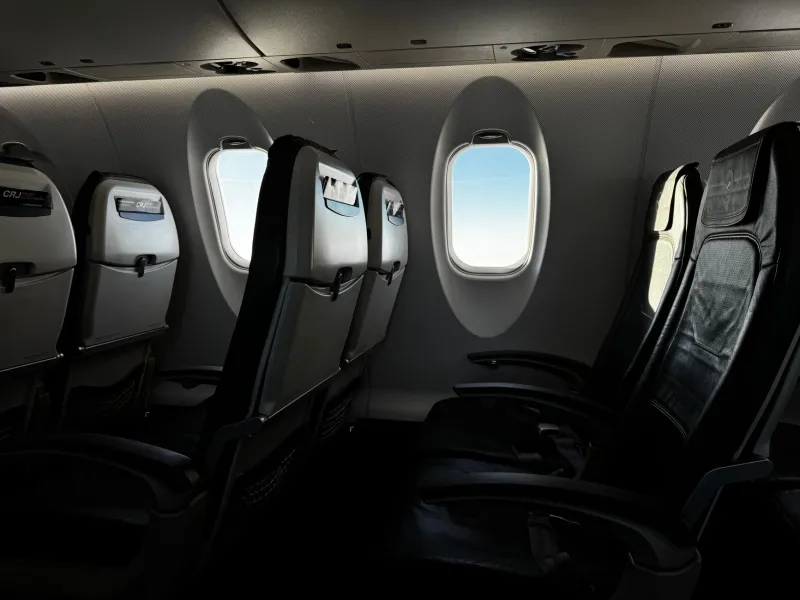
Over the past decade, US carriers have progressively equipped their fleets with larger IFE screens, seatback content systems, satellite connectivity hardware, antenna arrays, power distribution equipment, and the wiring infrastructure to connect all of it. Each individual component may be modest in weight. Collectively, the picture is more concerning, and the industry is only beginning to develop the analytical frameworks needed to quantify the full payload penalty.
Counting What Has Been Ignored
Traditional aircraft weight accounting has focused on structural components, engines, fuel systems, and passenger payload. Cabin systems were treated as a secondary consideration—important for passenger experience, but not a primary driver of operational economics. That framing is becoming increasingly difficult to sustain.
A fully equipped IFE seatback system on a modern widebody aircraft can add between 1.5 and 3 pounds per seat position when cabling, mounting hardware, and associated power electronics are included. On a twin-aisle aircraft with 300 seats, that translates to 450 to 900 pounds of IFE-related weight before accounting for overhead servers, cabin distribution units, satellite connectivity hardware mounted in the crown or belly, and the antenna systems on the fuselage exterior.
Connectivity hardware compounds the calculation. A full Ku-band or Ka-band satellite terminal installation—including the antenna, radome, RF electronics, and associated power conditioning equipment—can add several hundred additional pounds to an aircraft that previously had no such system. When airlines retrofit older aircraft with connectivity rather than specifying it at delivery, the weight is additive rather than optimized into the airframe design.
The fuel burn consequence is not linear, but it is real. Industry modeling consistently estimates that every 100 pounds of additional aircraft weight increases fuel consumption by approximately 0.5 to 1 percent over a typical mission, depending on aircraft type, route length, and operating altitude. Applied across a large narrowbody fleet operating hundreds of daily cycles, the aggregate fuel cost of unmanaged cabin system weight can reach into the millions of dollars annually.
Power-Over-Ethernet: Consolidating Functions, Reducing Mass
One of the most consequential architectural shifts in cabin systems design over the past several years has been the adoption of power-over-ethernet (PoE) as a distribution standard for IFE and connectivity endpoints. The appeal is straightforward: PoE allows a single cable run to deliver both data and low-voltage power to a seat electronics unit, eliminating the need for separate power wiring to each endpoint.
The weight savings from PoE adoption are meaningful at scale. Traditional cabin wiring architectures use dedicated power conductors running from centralized distribution units to each seat row, with data carried on separate cable bundles. Replacing that dual-cable architecture with a unified PoE network reduces the total length of copper conductor installed in the cabin, and copper is among the heaviest materials in a modern aircraft wiring harness.
Avionics engineers working on next-generation IFE platforms have noted that PoE architecture also simplifies installation and reduces the number of connectors and junction points in the system—each of which represents a potential failure mode as well as a weight contribution. Fewer connectors mean fewer points of maintenance attention over the aircraft's service life, which has operational cost implications beyond the initial weight reduction.
The limitation of PoE in this context is power budget. IEEE 802.3bt, the current high-power PoE standard, supports up to approximately 71 watts of delivered power per port—sufficient for most seatback display and content systems, but insufficient for high-wattage passenger charging applications. Airlines seeking to integrate both IFE and seat-level fast charging into a unified architecture must therefore design hybrid systems that combine PoE distribution for IFE endpoints with dedicated power delivery for charging outlets.
Solid-State Power Controllers: Intelligence Over Mass
Another technology reshaping the weight calculus of cabin power systems is the solid-state power controller (SSPC). Traditional circuit protection in aircraft electrical systems relies on mechanical circuit breakers—reliable, well-understood, but physically bulky when deployed at the scale required to protect individual cabin system circuits.
SSPCs replace mechanical switching elements with semiconductor-based devices that perform the same protective function at a fraction of the size and weight. A solid-state controller can monitor current draw, respond to fault conditions in microseconds, and reset electronically without physical intervention—capabilities that mechanical breakers cannot match.
For cabin power distribution, the implications are significant. An SSPC-based power distribution unit managing seat-level circuits across an entire cabin section can be substantially lighter than an equivalent mechanical breaker panel while offering finer-grained control over individual circuit loads. That control capability also enables load management strategies—such as dynamically limiting per-seat power delivery during peak demand periods—that are impractical with passive mechanical protection.
OEM integration of SSPC technology into new aircraft programs has accelerated, and the retrofit market for SSPC-based cabin power upgrades is growing. For airlines operating older aircraft with legacy mechanical distribution panels, SSPC retrofit programs represent an opportunity to simultaneously reduce weight and improve system intelligence.
The Materials Dimension: Lighter Wire, Smarter Routing
Beyond system architecture, material selection for cabin wiring is an active area of weight reduction effort. Aluminum conductors—used in place of copper for certain high-current runs—offer meaningful weight savings, though they require larger conductor cross-sections for equivalent current capacity and present different installation and termination requirements that demand engineering attention.
High-performance polymer insulation materials, replacing older and heavier insulation compounds, are reducing the per-foot weight of cabin wiring harnesses. Some integrators are also adopting optical fiber for data distribution where bandwidth requirements are high and weight savings are a priority, though fiber introduces its own termination complexity and is not universally applicable.
Cable routing optimization—using digital design tools to minimize total wire length in cabin harness designs—is a less visible but practically significant contributor to weight management. In complex cabin wiring projects, poorly optimized routing can add tens or hundreds of feet of unnecessary conductor length. At scale, that translates to measurable weight.
Balancing Connectivity Ambition Against Operational Reality
For airline operations executives, the practical challenge is not simply understanding the weight penalty of connected cabin systems—it is building that penalty into route economics and fleet planning models with sufficient accuracy to make informed investment decisions.
Carriers that treat IFE and connectivity hardware as off-balance-sheet additions to their aircraft—weight that is acknowledged but not systematically modeled in fuel burn projections—are likely underestimating the true cost of their connectivity investments. As sustainability reporting requirements expand and carbon accounting becomes more rigorous, the fuel burn consequences of cabin system weight will face greater scrutiny from both regulators and investors.
The engineering community has developed the tools to fight back against payload creep: PoE architectures, solid-state distribution, advanced materials, and optimized routing. Deploying those tools effectively requires that airlines and their technology partners treat weight as a first-order design constraint from the earliest stages of cabin upgrade planning—not an afterthought addressed after the connectivity requirements are already locked.
The connected cabin is not going to get lighter by accident. It will get lighter because the engineers and operators responsible for it decide that weight is a problem worth solving with the same rigor they apply to every other dimension of aircraft performance.