Fifty Seats, Full Expectations: The Regional Cabin Power Squeeze

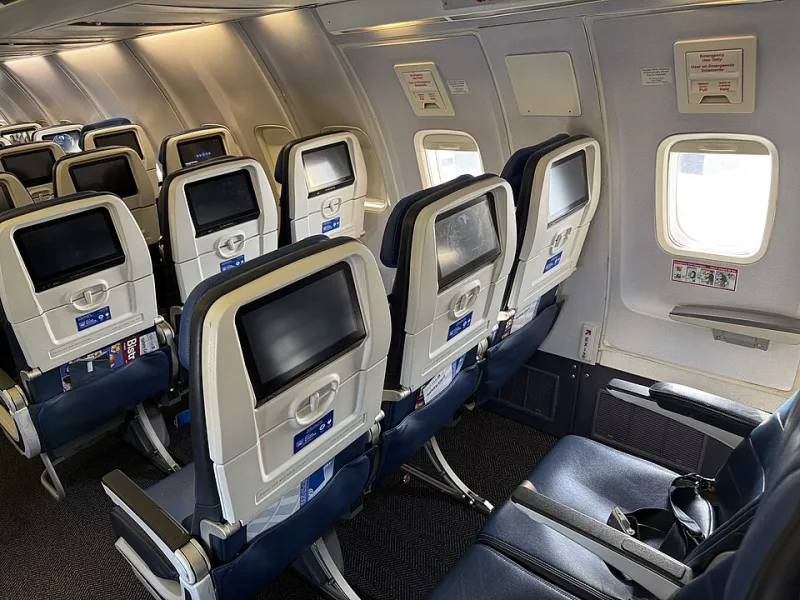
Photo: Alec Wilson, CC BY-SA 2.0, via Wikimedia Commons
For most of the past decade, the cabin power conversation in the United States has been conducted at 35,000 feet over widebody galleys and, more recently, over mainline narrowbody economy sections. The regional segment has been treated as a rounding error — a fleet of aircraft too small, too weight-sensitive, and too thinly margined to justify modern charging infrastructure.
That assumption is now under pressure. In 2026, the aircraft carrying 50 to 76 passengers are flying routes that are neither short nor incidental: hub-to-hub connectors of two and three hours, Essential Air Service links, and the long, thin city pairs that mainline equipment cannot serve profitably. The passengers on board are the same people who boarded a mainline jet an hour earlier, and they have already formed a view about what a seat should provide.
Why the segment was skipped, and why the reasons are weakening
The technical case for skipping regional aircraft has always been straightforward. These airframes were designed around modest electrical budgets, often built on 28-volt DC architectures with limited transformer rectifier capacity and generator headroom sized for the loads of the 1990s. Adding 60 watts to every seat in a 76-seat cabin implies roughly 4.5 kilowatts of connected load before any diversity factor is applied — a meaningful number on an airframe where a few hundred pounds of anything has operational consequences.
The economic case was equally clear. Certification costs for a supplemental type certificate do not shrink with aircraft size. A retrofit engineering package that spreads across a 400-aircraft fleet at mainline carrier scale has to be absorbed by fleets that may number in the dozens at a single operator. Per-seat installation cost on a regional jet has historically run multiples of the mainline equivalent.
What is weakening those arguments is not a technical breakthrough so much as a shift in who pays and who decides.
The capacity purchase agreement changes the calculus
Most US regional flying is conducted under capacity purchase agreements with mainline partners, and those agreements increasingly specify the passenger product in detail: seat pitch, Wi-Fi capability, cabin appearance, and, with growing frequency, power availability. When the product standard is set by the mainline brand rather than the operating certificate holder, cabin power stops being a discretionary investment and becomes a contractual obligation with a defined compliance date.
That reframing matters because it moves the question from return on investment to cost of compliance. An operator that cannot meet the specification risks the flying; an operator that meets it early gains negotiating position at contract renewal. Neither outcome depends on whether individual passengers pay for charging.
The electrical problem, in miniature
The engineering constraints are real, but they are not the obstacle they once were. Three developments have changed the picture.
First, charge-only architectures have become the norm for passenger-facing ports, removing the video and peripheral loads that once inflated per-seat power budgets. Second, port controllers and power conversion hardware have shrunk in both mass and volume, allowing distribution to move closer to the seat rather than requiring heavy central conversion. Third, distributed architectures with per-row or per-cluster conversion let designers apply realistic diversity factors instead of provisioning for worst-case simultaneous draw.
The remaining hard problems are less glamorous: wire routing through seat tracks on aging airframes, thermal management inside seat structures with limited airflow, circuit protection coordination on DC buses, and the certification basis itself. Aircraft certified under Part 23 commuter category rules present a different documentation path than those under Part 25, and operators pursuing a multi-model STC have to navigate both.
Weight is the currency, and it is not negotiable
On a 50-seat airframe, every retrofit competes with fuel, range, and payload. A charging installation that adds several hundred pounds across the cabin may be technically compliant and commercially unworkable on hot-and-high routes or at maximum range. This is why the credible proposals in the market are not simply mainline systems scaled down; they are designs that begin with a mass budget and work backward.
The practical implication for engineering teams is that the weight case must be built before the vendor shortlist, not after. Operators that arrive at a request for proposals without a firm allowance per seat tend to select on capability and then discover the operational penalty during entry into service.
What to watch through 2026 and beyond
The most contested ground is likely to be the 70- to 76-seat tier, where stage lengths are longest and the product gap with mainline narrowbodies is most visible to passengers. The 50-seat tier presents a harder business case but a clearer strategic one: these aircraft increasingly fly routes where there is no alternative, and passenger tolerance for an unpowered three-hour leg is not what it was.
Three signals are worth monitoring. The first is whether mainline partners begin writing specific wattage and port-count thresholds into capacity purchase agreements rather than describing power generically. The second is the emergence of pooled or shared certification packages that let smaller operators amortize STC costs across a consortium. The third is vendor behavior: when suppliers begin publishing regional-specific product lines with regional-specific weight figures, the market has genuinely moved.
Until then, the segment will remain what it has been — underserved, underestimated, and, for the operators who move first, an unusually durable source of differentiation.