Ground-Level Power Crisis: How APUs Are Failing to Keep Pace With the Modern Connected Cabin
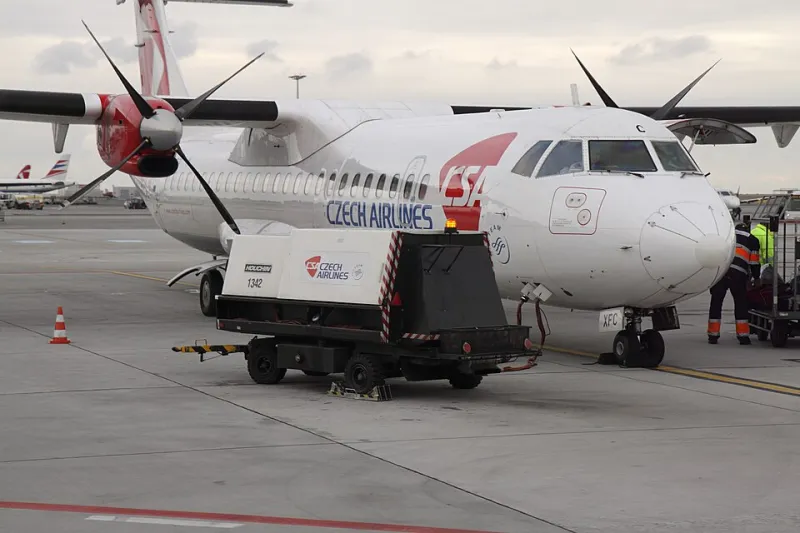
Photo: Petr Kadlec, CC BY-SA 3.0 cz, via Wikimedia Commons
For decades, the auxiliary power unit served a straightforward purpose: keep the lights on, maintain cabin climate, and support essential avionics while an aircraft sat at the gate. That role has grown considerably more complicated. Today's narrowbody and widebody aircraft are loaded with high-draw IFE servers, satellite connectivity hardware, USB-C charging infrastructure, and a passenger population that boards expecting every device to be fully charged before pushback. The APU, designed for an era of far more modest electrical demands, is struggling to keep up.
The result is a quiet but consequential bottleneck that is forcing airlines to make uncomfortable tradeoffs — and accelerating investment in alternative ground power strategies that, until recently, occupied the margins of fleet planning conversations.
The Demand Curve the APU Was Never Built For
Modern cabin technology has outpaced the electrical assumptions baked into aircraft designs that are still in wide commercial service. A single-aisle aircraft operating with a full IFE system, an active satellite Wi-Fi antenna array, and a cabin dense with USB-C and AC outlet infrastructure can draw substantially more power on the ground than the same airframe did a decade ago.
APUs on legacy narrowbodies were typically engineered to deliver between 90 and 115 kilovolt-amperes of electrical capacity. That was sufficient when the primary ground-power demands were cabin lighting, air conditioning, and basic avionics. The addition of high-throughput connectivity hardware alone can add meaningful load — satellite modems, routers, and associated cooling systems are not low-draw components. Layer in IFE server racks, galley equipment, and the collective draw of hundreds of passenger devices across a full cabin, and the APU's headroom narrows quickly.
Airlines operating hub-and-spoke networks in the United States, where aircraft cycle rapidly through multiple turns per day, are particularly exposed. Ground time is short, passenger expectations are high, and the pressure to have every system fully operational before boarding begins is unrelenting.
The Fuel Burn Equation
APU operation is not free. Fuel consumption for a running APU on a commercial narrowbody typically ranges from 150 to 250 pounds per hour depending on aircraft type and ambient conditions. For carriers managing tight unit costs across thousands of daily departures, that figure adds up to a meaningful line item — particularly when APU run times extend because systems require longer to initialize or cool down before shutdown.
The tension is direct: the more electrical demand a cabin generates on the ground, the longer the APU must run at higher output, and the more fuel is consumed before a single revenue mile is flown. Some operators have attempted to manage this by staggering system startups or delaying IFE initialization until closer to departure, but those workarounds carry their own risks, including incomplete system readiness and passenger dissatisfaction during early boarding.
For airlines with aggressive sustainability commitments — a growing segment of US majors and regional operators — APU fuel burn during ground operations represents a category of emissions that is increasingly difficult to justify when alternatives exist.
External Ground Power: The Infrastructure Answer
The most straightforward solution to APU overload is also the oldest: plug the aircraft into a ground power unit (GPU) and shut the APU down. Modern 400Hz fixed ground power systems, increasingly common at major US hub airports, can supply equivalent or greater electrical capacity than a running APU without the associated fuel burn or emissions.
The challenge is coverage. Gate-level GPU availability across the US airport network remains uneven. Many regional airports and secondary gates at larger facilities lack the fixed infrastructure to support high-capacity ground power, leaving aircraft dependent on mobile GPU equipment that may or may not be positioned and connected before APU shutdown is operationally feasible.
Airport infrastructure investment cycles are long, and the economics of installing fixed GPU systems at every gate require capital commitments that not all airport authorities have been willing to make. For airlines seeking a ground-power solution that doesn't depend on airport infrastructure upgrades, external GPUs solve only part of the problem.
Battery Storage Systems: A Newer Frontier
A more recent category of solutions involves integrating onboard or ground-side battery energy storage systems (BESS) into the gate power equation. These systems can absorb and store grid power during off-peak periods and discharge it at high rates during aircraft turnarounds, reducing both APU run time and the instantaneous demand placed on airport electrical infrastructure.
Several vendors active in the US market are now offering modular battery-based GPU alternatives that can be deployed at gates lacking fixed ground power connections. These units eliminate APU fuel burn during ground operations without requiring permanent electrical infrastructure upgrades — a compelling value proposition for operators at capacity-constrained regional airports.
On the aircraft side, some OEM and aftermarket programs are exploring the integration of supplemental battery systems that can buffer peak cabin loads, reducing the instantaneous draw placed on the APU during high-demand periods. While this technology remains in earlier stages of commercial deployment, the trajectory is clear: electrical storage is becoming a serious tool in the ground operations power management toolkit.
What Airlines Must Do Now
For US carriers evaluating their ground power strategy, the APU bottleneck problem is unlikely to resolve itself. Cabin electrical demands will continue to grow as connectivity hardware evolves and passenger device ecosystems expand. Waiting for APU technology to catch up is not a viable planning posture — APU design cycles are long, and the aircraft in current service will be flying for decades.
The more productive path involves a structured assessment of ground power availability across an airline's route network, identifying gates where APU dependency is highest and where GPU alternatives are either already available or could be cost-effectively deployed. Pairing that infrastructure audit with cabin load profiling — understanding precisely when and where peak electrical demand occurs during a typical turnaround — gives operators the data they need to prioritize investment.
For fleet planners and MRO teams, the APU capacity question also intersects with retrofit decisions. Adding significant new cabin electrical infrastructure without modeling the impact on APU loading during ground operations is a planning gap that is becoming increasingly costly to ignore.
The connected cabin is here. The power infrastructure required to support it — on the ground as much as in the air — is still catching up.