Before the Wheels Leave the Ground: How Gate-Side Power Quality Is Quietly Undermining Cabin Technology Performance

The conversation around cabin power reliability tends to begin at 35,000 feet. Engineers debate bus architecture, MRO teams troubleshoot in-seat unit failures, and airline executives scrutinize ancillary revenue lost to dead charging ports. What rarely enters that conversation is the hour before pushback — the window when a ground power unit (GPU) is the sole electrical lifeline sustaining an aircraft's systems. That window, it turns out, carries consequences that follow the aircraft into the sky.
Across major US airports, ground power infrastructure varies significantly in age, maintenance discipline, and output quality. The result is an industry-wide blind spot: a class of cabin technology failures that originates not in the aircraft's wiring or its power electronics, but on the ground, at the gate, before a single passenger boards.
What Ground Power Units Actually Do — and Where They Fall Short
A ground power unit supplies 400Hz AC power to a parked aircraft, replacing the electrical output that would otherwise come from the aircraft's auxiliary power unit (APU) or main engines. The rationale is straightforward: running an APU burns fuel, generates noise, and accelerates component wear. A functioning GPU is cleaner, quieter, and more economical.
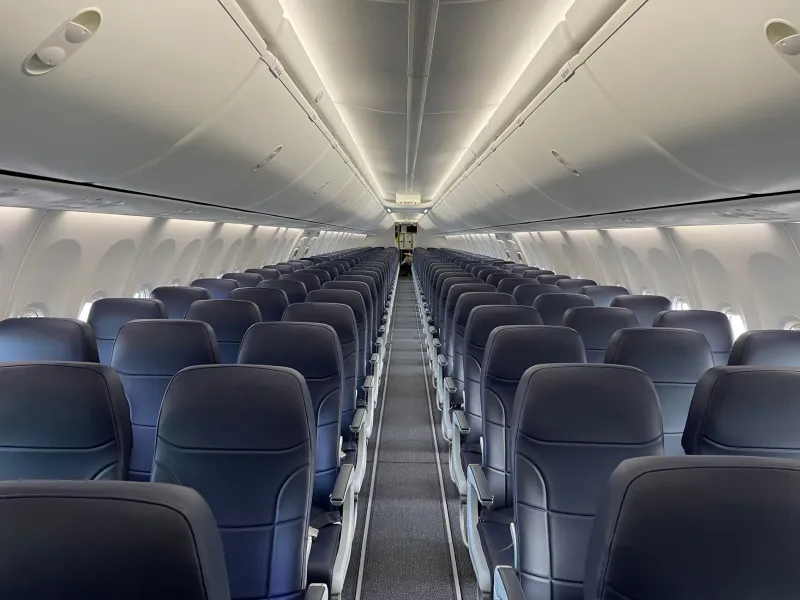
The operational logic is sound. The execution, however, is uneven. GPUs range from modern solid-state frequency converters capable of delivering tightly regulated voltage and frequency to aging rotary units that introduce harmonic distortion, voltage fluctuations, and transient spikes into the aircraft's electrical system. Modern connected cabins — equipped with seat-back displays, wireless access points, USB-C charging controllers, and cabin management systems — are sensitive loads. They were engineered to operate within narrow electrical tolerances. Feeding them through a degraded GPU is analogous to running precision laboratory equipment off an unstable generator.
The damage is rarely catastrophic and seldom traceable to a single event. Instead, it accumulates. Power controllers experience accelerated degradation. Solid-state components in in-seat power units absorb repeated transient events. Software-driven cabin systems reboot or log faults that maintenance crews later struggle to reproduce in a stable shop environment. The failures look intermittent. The root cause remains invisible.
The Patchwork of US Airport Ground Power Infrastructure
United States airport infrastructure does not operate under a single authority with uniform standards for GPU performance. Gate electrification — including the provision and maintenance of GPUs — falls variously to airport authorities, fixed-base operators, ground handling contractors, and in some cases the airlines themselves. This fragmented ownership structure produces wide variation in equipment quality and maintenance rigor.
At major hub airports, some gates have been upgraded with fixed in-ground power systems, which tend to deliver more consistent output than mobile GPU carts. However, even fixed systems can degrade if maintenance is deferred, and not all terminals at any given airport operate at the same standard. Regional airports and outstations, which serve a substantial portion of the US domestic network, frequently rely on older mobile units that may not have been load-tested or recalibrated in years.
Airlines operating narrow-body fleets across high-frequency domestic routes are particularly exposed. An aircraft cycling through six or eight city pairs in a single day may connect to a different GPU at every turn, each with its own output characteristics. The cumulative electrical stress on cabin electronics over a month of such operations is difficult to model precisely — and that difficulty is itself part of the problem.
Aircraft Batteries: The Overlooked Casualty
Beyond cabin electronics, GPU quality has direct implications for aircraft battery health. When ground power is unstable or improperly connected, aircraft batteries may be called upon to buffer voltage irregularities — a function they were not designed to perform continuously. Over time, repeated partial discharge and irregular charging cycles shorten battery service life and increase the frequency of unscheduled removals.
For airlines operating aircraft types where battery systems are both expensive and safety-critical — a category that has expanded considerably with newer-generation aircraft — this is not a peripheral concern. Battery replacement costs and the associated maintenance labor represent a quantifiable financial exposure. Yet few airlines have formal programs to correlate battery removal rates with GPU quality data at specific stations, largely because that data is rarely captured in a form that enables the analysis.
What Forward-Thinking Operators Are Doing Differently
A small but growing number of US carriers and airport operators are beginning to treat ground power quality as an infrastructure problem worthy of deliberate investment.
On the airport side, several major hubs have accelerated programs to replace mobile GPU fleets with fixed in-ground power systems tied to the commercial grid. These installations, when properly engineered, deliver stable 400Hz output without the mechanical variability of rotary equipment. The capital cost is substantial, but proponents argue that the reduction in aircraft maintenance events and APU operating hours justifies the expenditure over a reasonable time horizon.
On the airline side, the more progressive technical operations teams are beginning to instrument the problem. By deploying power quality monitoring at the aircraft level — logging voltage, frequency, and harmonic distortion data during ground operations — these carriers are building the datasets needed to identify which stations and which GPU assets are contributing disproportionately to cabin system anomalies. That intelligence, shared with airport partners and ground handlers, creates the basis for targeted remediation rather than wholesale infrastructure replacement.
Some MRO providers have also begun incorporating GPU compatibility assessments into cabin retrofit programs. When an airline installs new in-seat power systems or upgrades its cabin management architecture, the best practice is increasingly to audit the ground power environment at the aircraft's primary operating stations — not as an afterthought, but as a standard element of the engineering review.
Closing the Loop Between Ground and Air
The aviation industry has invested heavily in understanding what happens to power systems at altitude. The discipline of aircraft electrical load analysis is mature, well-documented, and subject to rigorous certification requirements. The equivalent discipline for ground power environments is considerably less developed.
That asymmetry is becoming harder to justify. As aircraft cabins grow more electrically complex — integrating high-density USB-C charging, satellite connectivity hardware, and software-defined cabin management platforms — the tolerance for upstream power quality problems narrows. The connected cabin is only as reliable as the weakest link in its power chain, and for a meaningful share of US domestic operations, that weakest link is sitting at the gate.
Addressing the problem does not require a single national standard or a federal mandate, though clearer industry guidance from bodies such as ATA and SAE International would accelerate progress. What it requires, first, is that airlines and airport operators recognize ground power quality as a shared infrastructure problem with direct consequences for passenger experience — and begin treating it accordingly.
The passenger who boards a flight only to discover a non-functional seat display or a charging port that fails to recognize a device has no visibility into what happened at the gate two hours earlier. The airline absorbs the complaint, the maintenance write-up, and the ancillary revenue loss. The GPU that caused it rolls on to the next aircraft.
That chain of events is preventable. Making it so begins with acknowledging that the flight experience starts on the ground.