Solid Promises, Uncertain Cells: The High-Stakes Bet Airlines Are Placing on Next-Generation Battery Technology

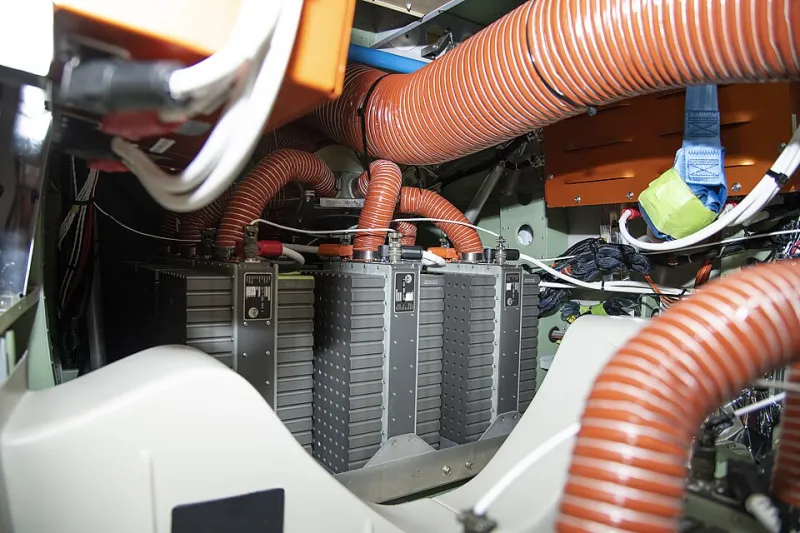
Photo: NASA / Tony Landis, Public domain, via Wikimedia Commons
For decades, aircraft auxiliary power was a solved problem. Lead-acid batteries performed their limited roles reliably, regulators understood their failure modes, and maintenance crews knew exactly what to expect when a cell degraded. That era of predictability is ending. Advanced lithium-ion and emerging solid-state architectures are now entering fleet discussions at major US carriers, and the transition is happening faster than the industry's safety and financial frameworks can comfortably accommodate.
The appeal is straightforward. Modern lithium chemistries offer energy density improvements that translate directly into weight savings, and in commercial aviation, weight savings translate directly into fuel economics. Solid-state configurations—still largely pre-commercial in aerospace applications—promise even greater gains alongside reduced thermal runaway risk. For operators managing aging fleets and tightening sustainability commitments, these figures are genuinely compelling. The problem is that compelling figures on a specification sheet and dependable performance across a 15-year operational lifecycle are not the same thing.
What the Manufacturers Are Selling
Battery suppliers pitching to airline procurement teams are offering lifecycle projections that would have seemed optimistic five years ago. Cycle counts in the thousands, calendar life estimates stretching to 15 or even 20 years, and maintenance cost reductions framed as near-certainties are now standard elements of the sales conversation. Some of these projections are grounded in genuine laboratory performance data. Others extrapolate aggressively from controlled conditions that bear limited resemblance to the thermal cycling, vibration profiles, and irregular charge patterns that characterize real-world aviation use.
Airlines, for their part, are under pressure to modernize. Competitors announcing next-generation cabin power architectures create a perception problem for operators who delay, regardless of whether the underlying technology has been validated at scale. Procurement decisions that should be driven by operational evidence are increasingly being shaped by competitive optics.
The Regulatory Gray Zone
The Federal Aviation Administration has made meaningful progress in establishing certification pathways for lithium-ion battery installations following the high-profile incidents that grounded the Boeing 787 fleet in 2013. Special Conditions and Advisory Circulars have clarified certain requirements, and the industry's understanding of thermal management obligations has matured considerably. However, the regulatory framework for next-generation solid-state architectures remains substantially incomplete.
Solid-state batteries present failure characteristics that differ meaningfully from conventional lithium-ion cells. The absence of liquid electrolyte changes both the nature of potential failure events and the detection methods that maintenance protocols rely upon. Current FAA guidance was not written with these chemistries in mind, and the gap between what operators are being asked to install and what regulators have formally addressed is wider than many procurement teams appreciate.
This is not an indictment of the FAA's responsiveness—the agency is actively engaged with industry on these questions. It is, however, a material risk factor that airlines should be pricing into their investment calculus. Operators who commit to fleet-wide installations before certification frameworks are finalized may find themselves managing compliance obligations that were not visible at the time of purchase.
When Year Eight Arrives Before Year Fifteen
Perhaps the most underexamined risk in the current battery procurement environment is what happens when a promised lifecycle does not materialize. Consider an airline that equips a narrowbody fleet with advanced lithium-ion auxiliary power batteries on the basis of a 15-year lifecycle projection. Seven years into the program, cell degradation data from the operational fleet begins diverging from the manufacturer's model. Capacity fade is accelerating. The projected replacement interval is no longer credible.
At that point, the operator faces a compounding set of problems. The original procurement agreement may or may not include performance guarantees with meaningful remedies. The supply chain for the specific cell chemistry may have shifted—manufacturers discontinue product lines, consolidate facilities, or exit market segments. Replacement inventory may not be available on the timeline that fleet maintenance requires. And the maintenance workforce, trained on the original installation, may need requalification on whatever substitute technology is sourced.
None of these scenarios is hypothetical. The commercial battery industry has a well-documented history of product discontinuations and supply chain disruptions, and aviation operators have not historically structured procurement agreements in ways that adequately protect against these outcomes.
Supply Chain Exposure That Isn't on the Radar
The geographic concentration of advanced battery cell manufacturing is a risk factor that aviation procurement teams are only beginning to incorporate into their analysis. A substantial portion of the lithium-ion cell supply chain runs through manufacturing facilities in Asia, and the solid-state sector is even more concentrated at this stage of its development. Geopolitical disruption, export control changes, or logistics shocks affecting these supply chains would have direct consequences for airlines that have standardized on specific cell chemistries across their fleets.
US carriers operating under FAA certification requirements cannot simply substitute an alternative cell chemistry without navigating a recertification process. An airline that finds its battery supplier unable to deliver faces a choice between grounding aircraft and operating with degraded auxiliary power systems while a replacement solution works through the approval pipeline. Neither option is acceptable at scale.
Building a More Defensible Investment Framework
None of this argues against the adoption of advanced battery technology. The performance advantages are real, and operators who develop genuine expertise in managing these systems will hold a meaningful long-term advantage over those who defer indefinitely. The argument is for a more rigorous approach to the investment decision.
Fleet operators evaluating battery technology upgrades should be demanding contractual lifecycle performance guarantees with defined remedies, not just warranty coverage for defects. Procurement agreements should address supply chain continuity obligations explicitly. Maintenance planning should incorporate degradation scenarios that diverge from manufacturer projections, not just the baseline case. And regulatory affairs teams should be engaged early in the process to map the current certification landscape against the specific technology being considered.
The airlines that will benefit most from the coming generation of aircraft battery technology are not necessarily those who move first. They are those who move with the clearest understanding of what they are committing to—and what they will do when the chemistry behaves like chemistry rather than a marketing document.