Stored Energy, Smarter Skies: How Onboard Battery Systems Could Redefine Aircraft Power Management
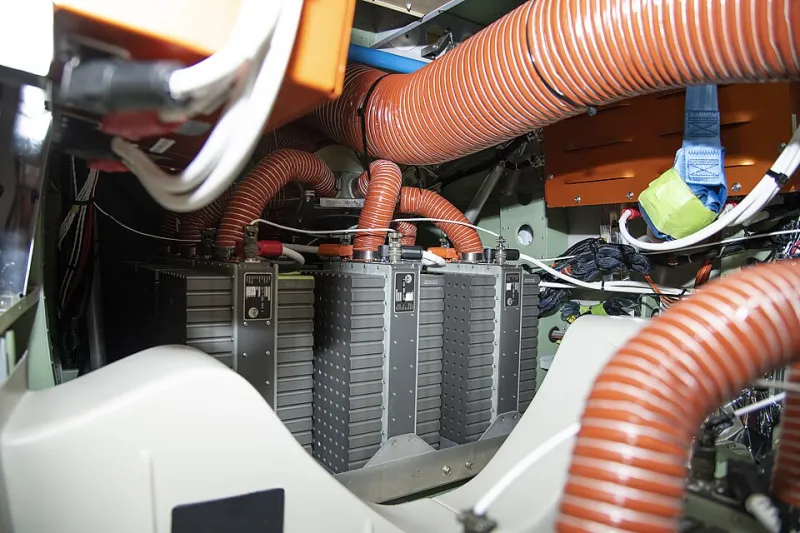
Photo: NASA Armstrong Flight Research Center / NASA/Lauren Hughes, Public domain, via Wikimedia Commons
For decades, aircraft power architecture has operated on a straightforward premise: engines generate electricity, that electricity flows through the aircraft's distribution system, and everything that draws power does so in real time. Storage was an afterthought—a backup function reserved for emergency systems and APU starting. That paradigm is beginning to fracture.
The rise of the connected cabin, the expansion of electrified galley and cabin management systems, and the broader industry push toward sustainable aviation are collectively exposing a structural limitation in how commercial aircraft store and allocate electrical energy. Battery systems—long treated as peripheral infrastructure—are increasingly being positioned as a foundational element of next-generation aircraft power strategy.
The question is no longer whether energy storage belongs on commercial aircraft. It is whether airlines are moving fast enough to understand its implications before the technology landscape shifts beneath them.
The Peak Demand Problem No One Talks About
Aircraft electrical systems are sized for peak load conditions. That design logic is both necessary and expensive. When every passenger seat is drawing power simultaneously, when galleys are operating at full capacity, and when avionics and cabin management systems are running in parallel, the instantaneous electrical demand on an aircraft can spike dramatically above its average baseline.
Conventional power architecture addresses this through over-engineering: generators, distribution buses, and wiring harnesses are all specified to handle worst-case simultaneous draw. The result is a system that is heavier, more complex, and more costly than would be required if demand could be buffered and smoothed over time.
This is precisely where battery-based energy storage introduces a compelling value proposition. By absorbing excess generation capacity during low-demand periods and discharging during peaks, an onboard storage system can reduce the effective sizing requirements for primary generation equipment. The weight savings from a right-sized generator, in theory, can offset a meaningful portion of the weight penalty introduced by the battery system itself.
For narrow-body aircraft operating high-frequency, short-haul routes—the backbone of most major US domestic networks—even modest reductions in fuel burn per cycle compound into substantial fleet-level savings across a full year of operations.
Taxi and Gate Operations: The Immediate Use Case
Beyond peak-shaving during flight, energy storage systems offer a more immediately actionable application: reducing or eliminating APU fuel burn during ground operations.
Auxiliary power units are among the least efficient components on a modern commercial aircraft. They consume jet fuel to generate electricity and pneumatic power during taxi, boarding, and gate turnarounds—periods when the aircraft is stationary or moving slowly and when ground power alternatives are theoretically available but not always practically accessible.
A sufficiently capable onboard battery system could allow an aircraft to arrive at the gate, disconnect from engine-driven generation, and sustain full cabin power—lighting, IFE, seat power, environmental controls—from stored energy rather than APU fuel burn. For carriers operating at airports where ground power infrastructure is unreliable or unavailable at all gates, this is not a theoretical benefit. It is a practical operational advantage.
Several regional and low-cost carriers in the United States have begun evaluating exactly this scenario. The economics are not yet universally favorable, but the calculus is improving as battery energy density continues to increase and as fuel costs remain elevated relative to historical averages.
Certification: The Barrier That Cannot Be Ignored
The technical case for onboard energy storage is increasingly well-understood. The regulatory pathway is considerably less clear.
The FAA's certification framework for lithium-ion battery systems on commercial aircraft was substantially reshaped following the Boeing 787 battery incidents in 2013. Those events prompted a comprehensive reassessment of thermal runaway risks, containment requirements, and monitoring system specifications that added both time and cost to any program seeking to integrate large-format battery systems into commercial aircraft.
For operators and manufacturers pursuing energy storage integration today, the certification burden remains significant. Battery systems must demonstrate compliance with FAR Part 25 airworthiness standards, satisfy fire and containment requirements that have grown more stringent in the post-787 environment, and pass through an FAA review process that, for novel installations, can extend across multiple years.
This regulatory timeline creates a structural challenge for airlines evaluating energy storage as a near-term operational solution. The technology development cycle and the certification cycle operate on fundamentally different timescales, and closing that gap requires early engagement with regulators—a step that many carriers have not yet prioritized.
Who Is Moving First
Among US operators, meaningful energy storage integration remains largely prospective rather than operational. The most advanced programs are concentrated in the electric and hybrid-electric aircraft development space, where startups and established aerospace manufacturers are building battery-primary propulsion architectures that require energy storage at a scale and sophistication far beyond anything currently flying commercially.
Heart Aerospace, Eviation, and several other developers are building regional aircraft programs around battery-electric propulsion—programs that, if they reach commercial service, will force US regional carriers to develop entirely new competencies around battery management, charging infrastructure, and energy storage maintenance.
For mainline operators, the more immediate applications are being explored in the context of auxiliary systems rather than propulsion. Collins Aerospace and several Tier 1 suppliers have active development programs focused on power management architectures that incorporate storage elements, and Boeing's ecoDemonstrator program has examined energy storage concepts as part of its broader sustainability research agenda.
The carriers most likely to move first are those with aggressive sustainability commitments, strong engineering organizations capable of managing novel certification programs, and route networks where the ground-operations fuel burn savings are most pronounced.
The Infrastructure Gap Airlines Must Address Now
Energy storage is not a technology that airlines can evaluate in isolation. An onboard battery system changes the fundamental architecture of an aircraft's power plant—how electricity is generated, distributed, monitored, and managed. It introduces new maintenance requirements, new ground support equipment needs, and new training demands for both flight crew and maintenance technicians.
For US carriers operating large, heterogeneous fleets across diverse operating environments, the complexity of that integration challenge is substantial. But the alternative—continuing to defer engagement with energy storage technology until it becomes operationally unavoidable—carries its own risks.
As electrified aircraft enter the regional market, as sustainability regulations tighten, and as passenger expectations around environmental responsibility continue to evolve, the airlines that have invested in understanding energy storage architecture will be meaningfully better positioned than those that have not.
The battery equation is not yet fully solved. But the variables are becoming clearer, and the cost of ignoring them is rising with every quarter that passes.