Connector Crossroads: Navigating the Fragmented Landscape of Cabin Charging Standards Before It Costs You
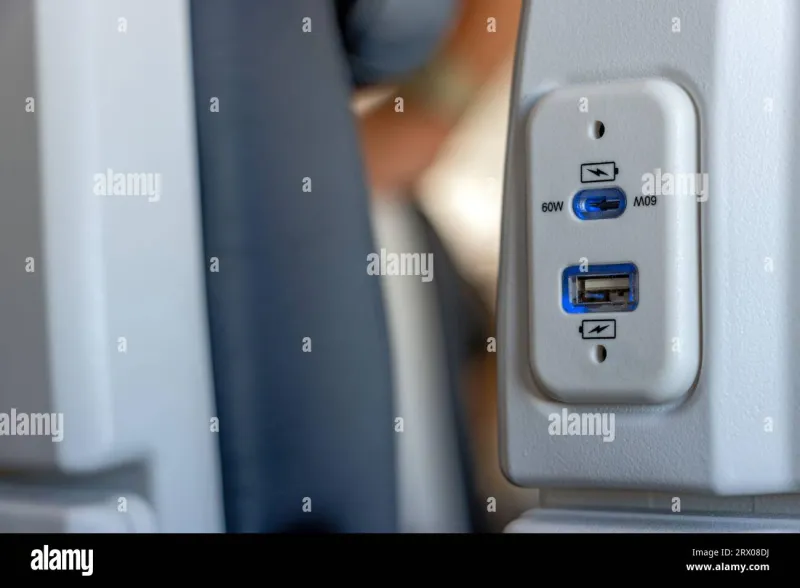
Photo: USB-C charging ports modern aircraft cabin seat technology close-up, via c8.alamy.com
In the consumer electronics industry, charging standards wars have a long and costly history. From the proliferation of proprietary laptop power connectors in the 1990s to the extended coexistence of Micro-USB, Lightning, and USB-C across the smartphone market, the pattern is familiar: competing standards fragment the ecosystem, impose costs on consumers and manufacturers alike, and eventually resolve—slowly and expensively—in favor of whichever approach achieves sufficient critical mass.
The commercial aviation cabin is now entering its own version of that conflict. As US airlines accelerate investment in seat power infrastructure, they face a connector and charging standard landscape that is simultaneously more complex and more consequential than most capital planning discussions acknowledge. The choices made today will define passenger experience and operational cost for aircraft that may remain in service through the late 2030s.
Getting this decision right requires understanding not just where charging technology stands today, but where the standards bodies, regulators, and device manufacturers are taking it—and how quickly.
The Current State: A Three-Way Fragmentation
The cabin power connector landscape in 2024 can be broadly characterized across three categories, each with distinct implications for airlines.
USB-A legacy infrastructure remains the dominant installed base across the US domestic fleet. Inexpensive to install, broadly compatible with the device ecosystem of a decade ago, and straightforward to maintain, USB-A outlets were the rational choice for the retrofit wave that swept through US carrier cabins in the 2010s. They are now increasingly misaligned with the device ecosystem they are meant to serve. Modern smartphones, tablets, and laptops are overwhelmingly USB-C native, and the adapters required to bridge that gap introduce points of failure, passenger frustration, and a charging experience that is measurably inferior to what passengers achieve at home or in the office.
USB-C and Power Delivery represents the current leading edge of the consumer electronics ecosystem and the most logical near-term direction for cabin power investment. The USB Power Delivery specification supports charging at up to 100 watts—sufficient for laptops as well as mobile devices—and the USB-C connector has achieved near-universal adoption across the Android ecosystem and is now standard on Apple's iPhone and iPad lines. For airlines evaluating new seat power installations today, USB-C Power Delivery is the most defensible choice based on current device compatibility.
Proprietary fast-charging systems complicate this picture. Qualcomm Quick Charge, Apple's proprietary fast-charging protocols, and several airline-specific implementations developed by IFE and seat power suppliers introduce performance advantages over baseline USB-C but require either hardware or software licensing arrangements and create compatibility questions that standard USB-C avoids. Several seat power suppliers have brought aviation-specific fast-charging products to market that claim meaningful improvements in charging speed for compatible devices—claims that are technically accurate but that obscure the compatibility limitations for devices outside the supported ecosystem.
Why Standardization Matters More in Aviation Than in Consumer Electronics
In the consumer market, a passenger who encounters an incompatible charging standard at a coffee shop can simply visit a different coffee shop. In the cabin of a commercial aircraft at 35,000 feet, there is no alternative. The charging infrastructure at the seat is the only option available, and its compatibility with the passenger's specific device and cable combination determines whether that passenger arrives at their destination with a functional device or a depleted one.
This captive environment makes the standardization question in aviation more consequential than in almost any other context. An airline that installs seat power infrastructure built around a standard that becomes obsolete or that fails to achieve broad device compatibility does not merely inconvenience passengers—it actively degrades the value proposition of its cabin product in a way that is visible, measurable, and increasingly influential in booking decisions.
The operational cost dimension adds another layer of urgency. Seat power components are certified aircraft parts. Replacing them is not a matter of swapping out a consumer device—it requires engineering analysis, regulatory compliance documentation, and maintenance labor that collectively make a seat power retrofit a material capital expenditure. An airline that installs USB-A today and finds itself needing to replace it with USB-C in three years has effectively paid twice for the same functional outcome.
Industry Groups and the Path Toward Consensus
Several industry bodies are actively engaged in efforts to bring greater coherence to the cabin power standards landscape, though progress has been uneven.
AERONAUTICAL Radio, Incorporated (ARINC) has published standards governing cabin power system interfaces that are widely referenced in new aircraft programs and retrofit specifications. The ARINC 628 standard and related documents provide a framework for how seat power systems should interface with aircraft electrical architecture, but they do not fully resolve the connector-level standardization question that airlines face in practice.
The Airlines for America (A4A) technology working groups have addressed cabin connectivity and power standards in the context of broader IFE and cabin management system specifications, and there is growing engagement from major US carriers in pushing for clearer connector-level guidance that would simplify procurement and reduce long-term compatibility risk.
At the international level, the IATA working groups on cabin standards have similarly identified charging standardization as a priority area, with particular attention to the implications of European Union regulatory mandates requiring USB-C adoption across consumer electronics—mandates that will, over time, make USB-C the de facto universal standard for portable device charging in all markets where EU regulations apply or influence product design.
How Airlines Can Future-Proof Their Investments
Given the current state of the standards landscape, airlines making cabin power investment decisions today should consider several practical principles.
Prioritize USB-C Power Delivery as the primary seat power interface. The device ecosystem trajectory is sufficiently clear that USB-C represents the lowest-risk primary interface for new installations. Backward compatibility with USB-A legacy devices can be addressed through adapter availability rather than dual-port installations that add weight and cost.
Avoid proprietary fast-charging commitments without clear ecosystem analysis. The performance benefits of proprietary fast-charging protocols are real but narrow. Before committing to a supplier's proprietary implementation, airlines should require clear documentation of which devices and cable combinations achieve the claimed performance advantages—and what the charging experience looks like for devices outside that supported set.
Engage suppliers on upgrade path clarity. The seat power suppliers serving the US market vary considerably in how clearly they can articulate the upgrade path from current-generation products to future specifications. Suppliers who can demonstrate a credible roadmap for transitioning installed hardware to emerging standards—whether through firmware updates, modular component replacement, or defined retrofit programs—represent a meaningfully lower long-term cost exposure than those whose roadmap is opaque.
Monitor regulatory developments closely. The EU's USB-C mandate for consumer electronics has already influenced global product design cycles. As regulatory attention to aviation cabin standards increases—both in the US and internationally—airlines that have stayed close to the regulatory conversation will be better positioned to anticipate compliance requirements before they become urgent.
The connector standards war in the aircraft cabin will eventually resolve, as all such conflicts do. The airlines that emerge from it in the strongest position will be those that approached the question with strategic discipline rather than reacting to whatever was cheapest or most familiar at the moment of each procurement decision.